
Exploring the opportunities, risks, and important differences between residential and commercial real estate investing.
From Rental Homes to Commercial Properties
Imagine an investor who has spent the past decade building a small portfolio of rental homes.
Over the years, those properties have generated rental income, appreciated in value, and gradually built equity as mortgage balances declined.
The investor understands residential real estate. They know how to evaluate neighborhoods, estimate rental income, budget for repairs, and work with tenants.
But recently, a different question has come to mind:
“Should I consider investing in commercial real estate?”
Perhaps they’ve noticed a small retail building, a professional office condominium, or a warehouse in a growing part of town.
They wonder whether commercial properties could provide another way to generate income and build long-term wealth.
It’s a reasonable question. But before making that transition, investors need to understand an important distinction:
Commercial real estate is not simply residential real estate on a larger scale.
It operates differently, carries different risks, and often requires a different approach to financing and investment analysis.
1. What Is Commercial Real Estate?
Commercial real estate generally refers to properties used for business or income-producing purposes.
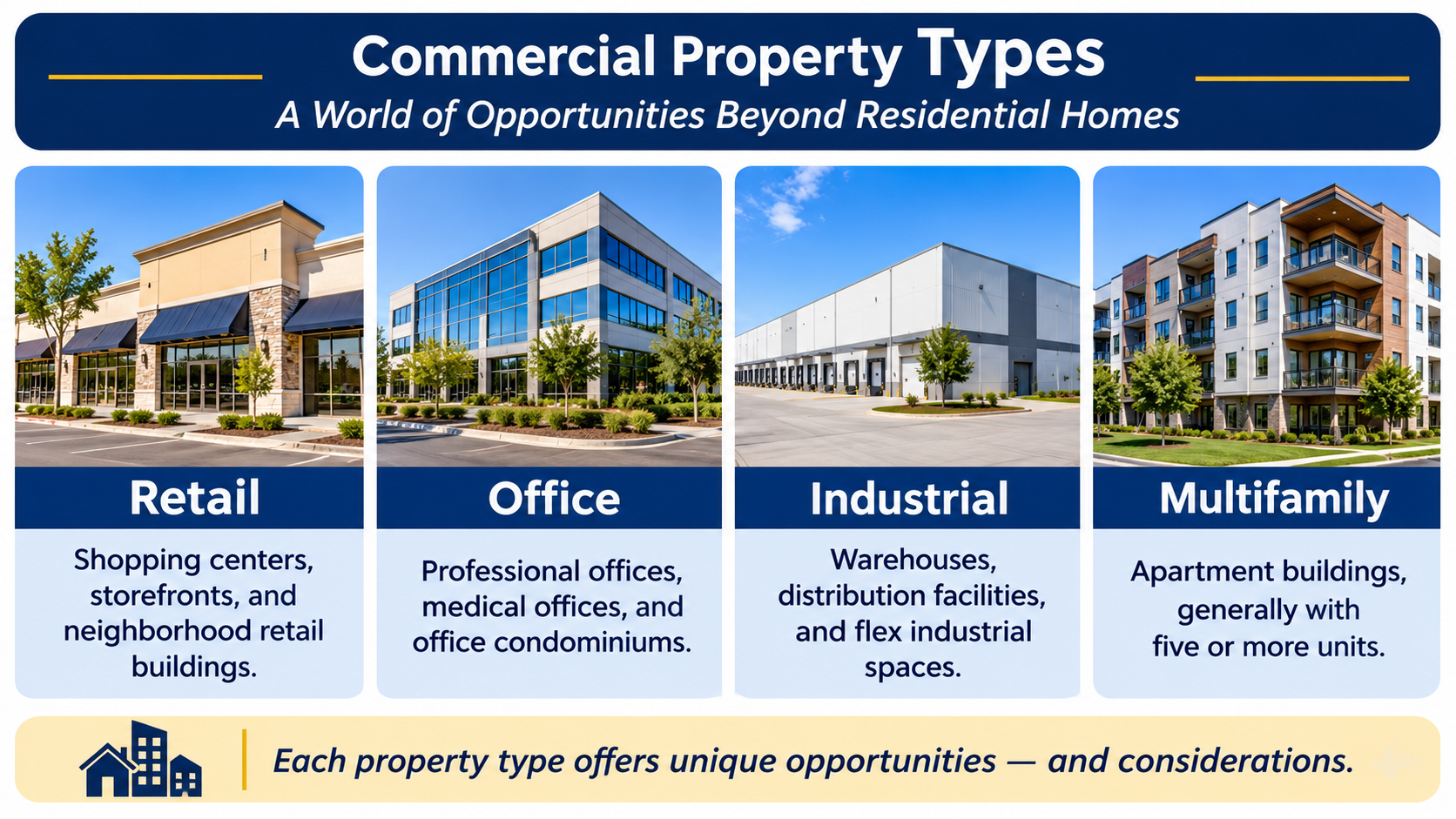
Common categories include:
- Retail: Shopping centers, storefronts, and neighborhood retail buildings.
- Office: Professional offices, medical offices, and office condominiums.
- Industrial: Warehouses, distribution facilities, and flex industrial spaces.
- Multifamily: Apartment buildings, generally with five or more residential units for commercial lending purposes.
- Special-purpose properties: Hotels, self-storage facilities, and certain other specialized properties.
Each category has its own characteristics.
For example, a small warehouse leased to an established business may operate very differently from a neighborhood shopping center with multiple retail tenants.
The property type matters, but so do its location, tenant demand, lease terms, and operating expenses.
2. How Commercial Real Estate Creates Wealth?
If you’ve read our article The Five Ways Real Estate Creates Wealth, you’re already familiar with the fundamental mechanisms through which real estate investments can build wealth:
Cash flow, appreciation, mortgage paydown, tax benefits, and leverage.
These principles also apply to commercial real estate.
However, the way they operate can be quite different.
For example, a residential rental home’s value is often influenced heavily by comparable home sales.
A commercial investment property’s value may depend more directly on the income it generates, the reliability of that income, prevailing market capitalization rates, and its future leasing prospects.
This makes financial analysis especially important.
A commercial property with an attractive purchase price isn’t necessarily a good investment if its rental income is uncertain or its future expenses are underestimated.
3. Residential vs. Commercial: What Changes?
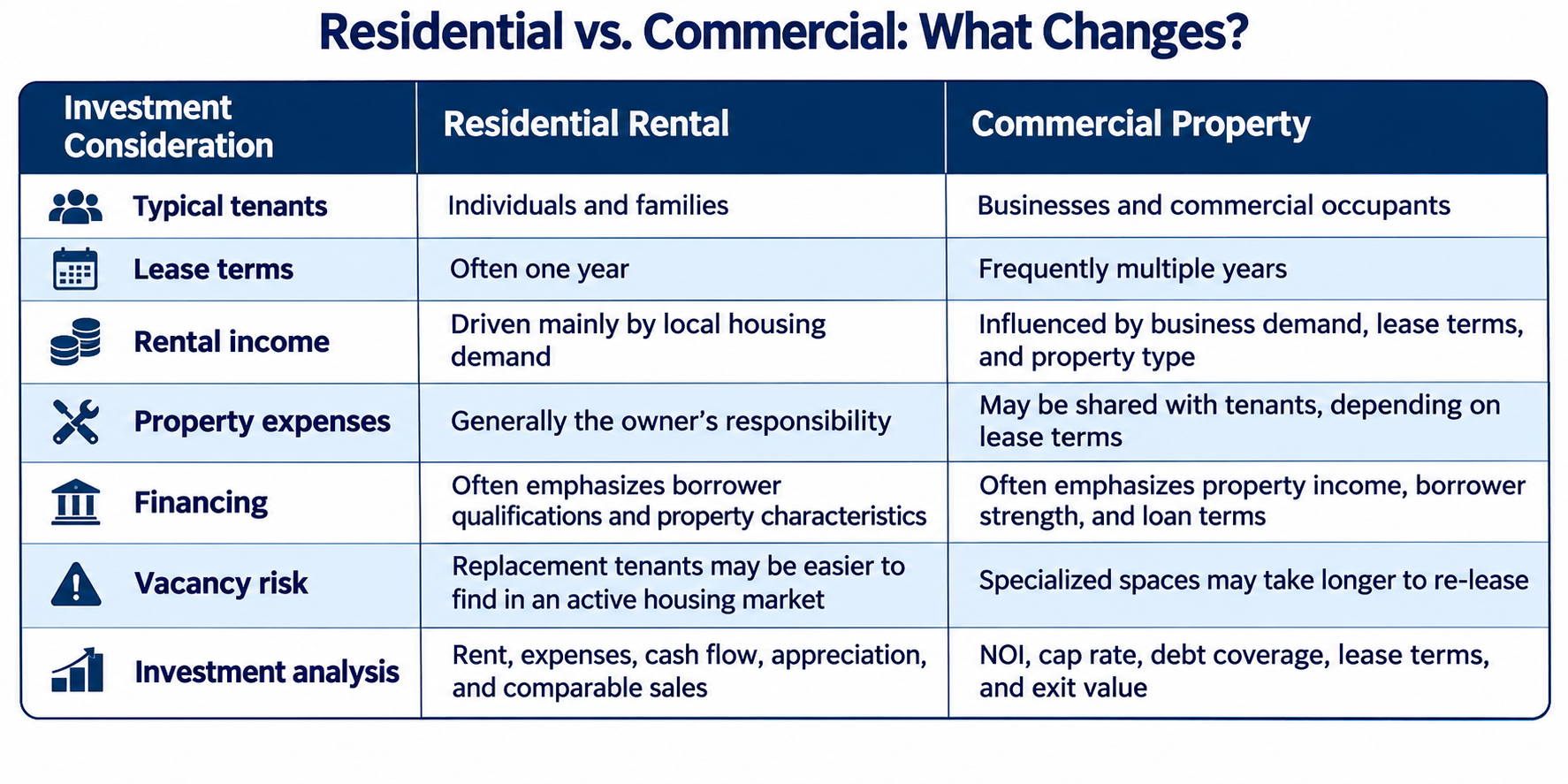
Neither category is automatically better.
The appropriate investment depends on the investor’s objectives, available capital, experience, and ability to manage risk.
4. Understanding Commercial Property Income
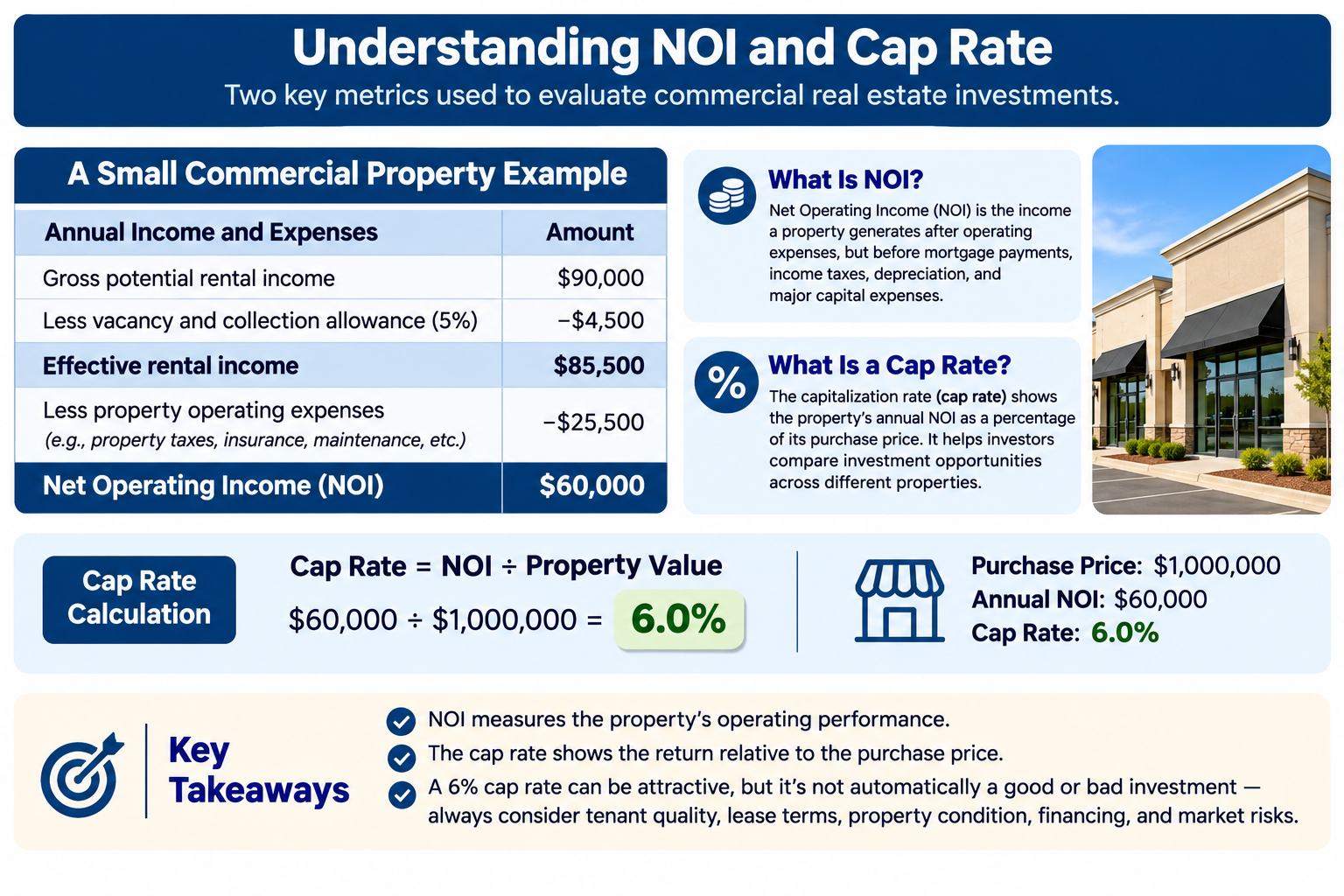
One of the most important concepts in commercial investing is Net Operating Income (NOI).
NOI represents the income a property generates after accounting for operating expenses, but before mortgage payments, income taxes, depreciation, and certain capital expenditures.
Consider a simplified example:
A Small Commercial Property
| Annual Income and Expenses | Amount |
|---|---|
| Gross potential rental income | $90,000 |
| Less vacancy and collection allowance | −$4,500 |
| Effective rental income | $85,500 |
| Less property operating expenses | −$25,500 |
| Net Operating Income (NOI) | $60,000 |
Suppose the property is offered for $1,000,000.
Its capitalization rate, commonly called the cap rate, would be:
Cap Rate = NOI ÷ Property Value
$60,000 ÷ $1,000,000 = 6.0%
A 6% cap rate means the property’s annual NOI represents 6% of its purchase price before financing.
But the cap rate alone doesn’t tell us whether the investment is attractive.
We also need to evaluate the property’s condition, tenant quality, lease expiration dates, future capital expenses, financing costs, and potential resale value.
A 6% cap rate is not necessarily better or worse than another investment’s cap rate without understanding the underlying risks.
5. The Biggest Difference May Be Tenant Risk
Consider two investments.
The first is a single-family rental home in a desirable residential neighborhood.
The second is a small commercial building occupied by one business tenant.
Both properties are currently leased.
If the residential tenant moves out, the owner may be able to find another tenant relatively quickly, depending on market conditions and the property’s competitiveness.
But what happens if the commercial tenant closes its business or decides not to renew its lease?
The owner may face a much longer vacancy.
Finding a replacement tenant could require renovations, leasing commissions, rent concessions, or improvements tailored to the new business.
This is why experienced commercial investors pay close attention to tenant creditworthiness, lease terms, market demand, and the property’s ability to attract replacement tenants.
A commercial property’s income is only as dependable as the business fundamentals supporting it.
6. Commercial Financing Works Differently
Residential investors may be familiar with conventional mortgages, investment-property loans, or debt-service coverage ratio (DSCR) loans.
Commercial financing introduces additional considerations.
Lenders may evaluate:
- The property’s Net Operating Income and its ability to cover debt payments.
- The borrower’s financial strength and commercial investment experience.
- The required down payment and loan-to-value ratio.
- The property’s condition, use, and tenant occupancy.
- Loan maturity, amortization period, and potential balloon-payment obligations.
Unlike a typical 30-year residential mortgage, some commercial loans have shorter contractual terms even when payments are calculated using a longer amortization schedule.
This can introduce refinancing risk when the loan matures.
For investors, understanding the financing structure is just as important as evaluating the property’s income.
7. Should You Make the Transition
Commercial real estate may be worth exploring if you:
- Already have experience owning and managing investment properties.
- Have sufficient capital for the down payment, reserves, and unexpected expenses.
- Want to evaluate opportunities beyond traditional residential rentals.
- Are comfortable analyzing business tenants, commercial leases, and property-level financial statements.
- Have a long-term investment strategy that accounts for vacancy, financing, and eventual resale.
On the other hand, residential real estate may remain the better fit for investors who prefer familiar property types, smaller investments, or a broader pool of potential tenants and buyers.
There is no requirement to move into commercial real estate simply because your residential portfolio has grown.
The next investment should improve your overall strategy—not merely make your portfolio more complicated.
8. Start With the Investment Strategy, Not the Property
One of the most common mistakes investors make is becoming interested in a particular property before clearly defining their investment objectives.
A commercial listing may look attractive because of its location, asking price, or advertised return.
But a sound investment decision begins with questions such as:
- Am I primarily seeking current income, long-term appreciation, or both?
- How much capital can I invest without compromising liquidity?
- What vacancy and financing risks can I tolerate?
- Do I understand the property type and its local tenant market?
- How easily could I sell the property when my investment objectives change?
These questions should guide the property search—not the other way around.
Final Thoughts: An Opportunity Worth Understanding
Commercial real estate can offer opportunities for income generation, diversification, and long-term wealth creation.
But those opportunities come with different responsibilities, financing structures, and risks.
For residential investors considering their next step, the best starting point isn’t necessarily purchasing a commercial building.
It’s learning how commercial investments work and determining whether they fit your broader financial objectives.
At U.S. Delta Realty, we believe smarter investment decisions begin with understanding the market, evaluating the numbers, and recognizing the risks before committing capital.
Thinking about expanding beyond residential rental properties? Let’s have a conversation about your investment objectives and the opportunities worth exploring.
U.S. Delta Realty
Helping You Make Smarter Real Estate & Financing Decisions.
Educational information only. Examples are hypothetical and do not represent an investment recommendation or guaranteed return. Financing terms, tax treatment, and investment outcomes depend on individual circumstances.