
How Real Estate Investments Actually Create Wealth
For many individuals, real estate has long been considered one of the most powerful tools for building long-term wealth. From rental homes and apartment buildings to commercial properties and land, real estate has helped countless investors create income, preserve purchasing power, and achieve financial independence over time.
But despite its popularity, many people enter real estate investing without fully understanding how wealth is actually created through real estate ownership. Some believe prices will simply continue to rise forever. Others focus only on monthly cash flow while ignoring risk and long-term strategy.
In reality, successful real estate investing is rarely based on luck or speculation. It is usually the result of disciplined decision-making, careful analysis, and a clear understanding of the different ways a property can generate value over time.
Understanding these fundamentals is critical before making any investment decisions.
The 5 Ways Real Estate Creates Wealth
One of the unique strengths of real estate is that it can create wealth through multiple channels simultaneously. A well-selected investment property may generate monthly income, increase in value, reduce debt over time, and provide tax advantages — all at the same time.
Below are the five primary ways investors build wealth through real estate

1. Cash Flow
Cash flow is the money remaining after collecting rent and paying all property-related expenses.
These expenses may include:
- mortgage payments,
- property taxes,
- insurance,
- repairs and maintenance,
- HOA fees,
- vacancies,
- and property management costs.
If the property produces more income than expenses, the investor has positive cash flow.
For many investors, cash flow provides:
- supplemental monthly income,
- financial stability,
- a long-term income stream that is less dependent on daily labor compared to traditional employment.
However, positive cash flow should never be assumed. A property that appears profitable at first glance may become financially stressful if expenses are underestimated or rental demand weakens.
Strong investors analyze cash flow carefully before purchasing a property.
2. Appreciation
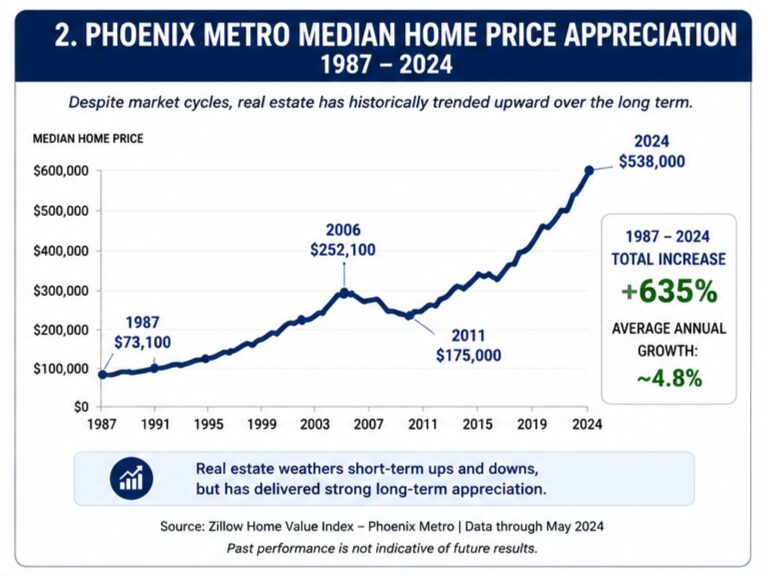
Appreciation refers to the increase in a property’s value over time.
Real estate values may rise due to:
- population growth,
- job growth,
- limited housing supply,
- inflation,
- neighborhood improvements,
- and overall economic expansion.
Historically, many areas of the Phoenix metropolitan region have experienced strong appreciation due to continued migration, business growth, and housing demand.
However, appreciation should never be treated as guaranteed. Real estate markets move in cycles. Prices may rise quickly during strong markets and decline during economic downturns.
Experienced investors understand that appreciation is important, but relying on appreciation alone can create significant risk.
3. Mortgage Paydown

One of the most overlooked wealth-building benefits of real estate investing is mortgage paydown.
When an investor finances a property using a mortgage, a portion of each monthly payment reduces the loan balance. Over time, the tenant effectively helps pay down the investor’s debt.
As the mortgage balance declines, the investor’s equity in the property increases.
This process may seem slow initially, but over many years it can become a significant contributor to long-term wealth accumulation.
4. Tax Benefits
Real estate investments may also provide important tax advantages.
Depending on an investor’s situation, potential benefits may include:
- depreciation,
- mortgage interest deductions,
- expense deductions,
- and capital gains strategies such as 1031 exchanges.
These tax benefits can improve the overall performance of an investment property and help preserve investment returns over time.
Because tax laws can be complex and change frequently, investors should always consult qualified tax professionals regarding their specific situations.
5. Leverage
Real estate is one of the few investment vehicles that allows individuals to control a large asset using borrowed money.
For example, an investor may purchase a $500,000 property using only a portion of their own cash while financing the remaining balance through a mortgage.
When used carefully, leverage can significantly accelerate wealth creation because the investor benefits from appreciation and equity growth on the full property value — not just the cash invested.
However, leverage also increases risk.
Excessive debt, rising interest rates, unexpected vacancies, or declining property values can place financial pressure on investors who are overleveraged.
Leverage is powerful, but it must be used responsibly.
Why Some Real Estate Investors Fail
Although real estate can create tremendous wealth, not every investor succeeds.
Many investment failures are not caused by real estate itself, but rather by poor decision-making and lack of preparation.
Common mistakes include:
- overpaying for properties,
- underestimating repair costs,
- relying entirely on appreciation,
- maintaining insufficient cash reserves,
- using excessive leverage,
- or purchasing properties without understanding the local market.
During the 2006–2010 housing crash, many investors purchased properties aggressively without fully understanding risk exposure. When market conditions changed, they found themselves holding properties they could no longer support financially.
Successful investing requires discipline, patience, and realistic expectations.
Real estate is not a “get rich quick” business. Real estate is NOT either truly “passive” in the purest sense — especially at the beginning.
Many investors, especially newer ones, are attracted to real estate investing because of hype, oversimplification, and unrealistic promises often seen online and on social media
When people say, “real estate creates passive income,” it should be interpreted that, “real estate CAN eventually create income that is less dependent on your daily labor.”
Below is a simplified chart, clarifying the types of real estate investment and the investor’s involvement.
| Type of Investment | Passive Level |
| Flipping houses | Very active |
| Self-managing rentals | Moderately active |
| Rentals with property managers | Semi-passive |
| Syndications / REITs | More passive |
Different Types of Real Estate Investors
Not all investors have the same goals.
Some investors prioritize:
- strong monthly cash flow,
- while others focus on long-term appreciation.
Some investors prefer:
- stable rental properties,
- while others pursue renovations, flips, or development opportunities.
Common investment approaches include:
- buy-and-hold investing,
- fix-and-flip strategies,
- BRRRR (Buy, Rehab, Rent, Refinance, and Repeat) investing,
- short-term rentals,
- and passive syndication investments.
Understanding your own investment goals and risk tolerance is an important part of developing a successful long-term strategy.
Why Real Estate Investing Requires Patience
Real estate investing often appears simple from the outside, but successful investing requires:
- market knowledge,
- financial discipline,
- emotional control,
- and long-term thinking.
Properties require maintenance.
Tenants may create challenges.
Markets fluctuate.
Unexpected expenses occur.
The most successful investors usually approach real estate as a long-term business rather than a short-term gamble.
Over time, disciplined investors who continue learning and improving their decision-making processes often place themselves in strong financial positions.
Real Estate Investing in the Phoenix East Valley
The Phoenix metropolitan area — especially East Valley cities such as Chandler, Gilbert, Mesa, Queen Creek, Scottsdale, and Tempe — continues to attract both homeowners and investors due to:
- population growth,
- expanding employment opportunities,
- business-friendly policies,
- and strong long-term housing demand.
Different areas offer different investment characteristics.
Some neighborhoods may provide stronger cash flow opportunities, while others may offer greater long-term appreciation potential.
Understanding these local differences is critical when evaluating investment opportunities in Arizona.
Final Thoughts
Real estate investing can be an excellent tool for building long-term wealth, but successful investing requires more than simply buying property.
It requires:
- education,
- careful analysis,
- risk management,
- and a long-term mindset.
The more investors understand how real estate actually creates wealth, the better positioned they are to make informed and confident decisions.
At U.S. Delta Realty, we believe informed investors make better investors. Our goal is to help clients navigate real estate opportunities thoughtfully, strategically, and with a clear understanding of both risks and rewards.
Because ultimately, successful investing is not about chasing hype or speculation — it is about building sustainable wealth over time.